An AI agent proposal may include a chat screen or an automated process demo. A demo is useful for seeing possibilities, but it does not show how the proposal will handle your data, permissions, exceptions, and reviewers.
When comparing companies, ask not only what they will build but also how they will understand the work, verify it, and improve it after launch. A useful sign is whether the technology explanation connects to the business explanation.
Check business understanding through questions and deliverables
Ask which part of the current work will change and which decisions remain with people, not only what the AI can do. Look for questions about field terminology and exceptions, and check whether the answers appear in the scope or workflow materials.
When the interview becomes a list of screens, data, reviewers, and exceptions, the proposal is easier to compare. Check whether the result of the business discussion appears in documents or a prototype.
- Defines included and excluded work
- Asks about field exceptions and decision branches
- Organizes inputs, processing, outputs, and reviewers
- Carries business understanding into documents or a prototype
Review integration with existing systems in concrete terms
Using an agent in daily work may require information from current systems or files and a way to return the result. Check whether the company asks about data owners, authentication, permissions, and update methods.
Compare proposals by read and write scope, sync method, retry after failure, and log ownership rather than accepting only a general statement that integration is possible.
- How current systems and files will be reviewed
- Permission design for reading, registering, and updating
- Sync schedule and failed-integration handling
- Authentication, logs, and retry operations
Ask how quality will be evaluated before launch
Quality is not proven by one successful demo. Use realistic inputs to check whether the output contains what the business needs, avoids unsafe actions, and is easy for a person to review.
Ask for the evaluation inputs, pass conditions, return conditions, and re-evaluation process. Also ask who performs the evaluation and how the rules change when the business changes.
Confirm permissions, logs, and stop conditions
Business data may be visible to one user but not another. Ask whose permissions the agent uses, what it may read or change, and which actions require human approval. Stop conditions are important wherever an automated action could have a large impact.
Ask whether the system records when, by whom, and from which input an action was taken. Also confirm how to stop, review, and resume the process if something goes wrong.
- Information visible by role or user
- Actions that require human approval
- History of inputs, outputs, and execution
- How to stop, return, and resume a task
Compare post-launch operations and improvement
After launch, reference material, business rules, user questions, error checks, and improvement requests will change. Ask who receives questions, what can be changed by configuration, and what becomes development work.
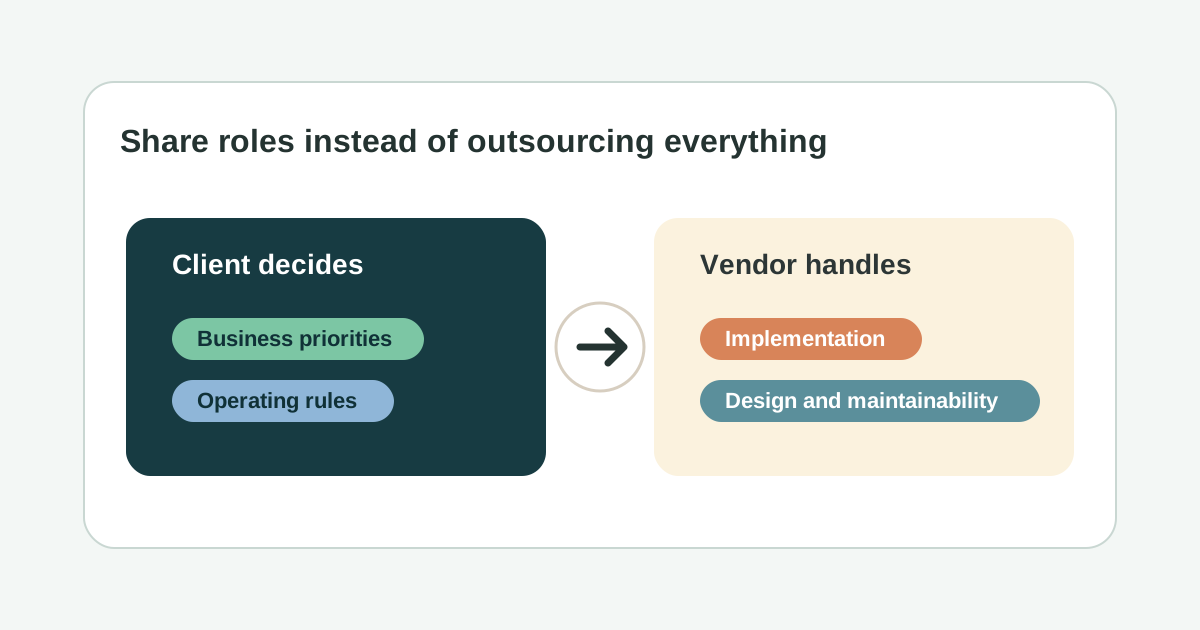
If the initial developer, operating contact, and improvement decision-maker are different, ask for their roles and communication path in writing. Compare whether the company can help prioritize improvements, not only whether it offers support.
- Owner for reference material and business rules
- Contact for questions, incidents, and improvements
- Boundary between configuration and additional development
- Process for revising evaluation and prioritizing improvements
Summary
- Check business-understanding deliverables, not only the demo
- Ask about integration, permissions, and failure handling
- Align evaluation inputs, pass conditions, and re-evaluation
- Confirm logs, stopping, approval, and returning a task
- Compare post-launch questions and improvement ownership